NFT Pump Size: Flow Rate and Head Height Guide
Written by Matt W on 20th Aug 2026.
An NFT pump must deliver the required channel flow at the real lift height. The headline litres-per-hour figure is measured without your pipework. Size the pump after counting channels and measuring the vertical lift.
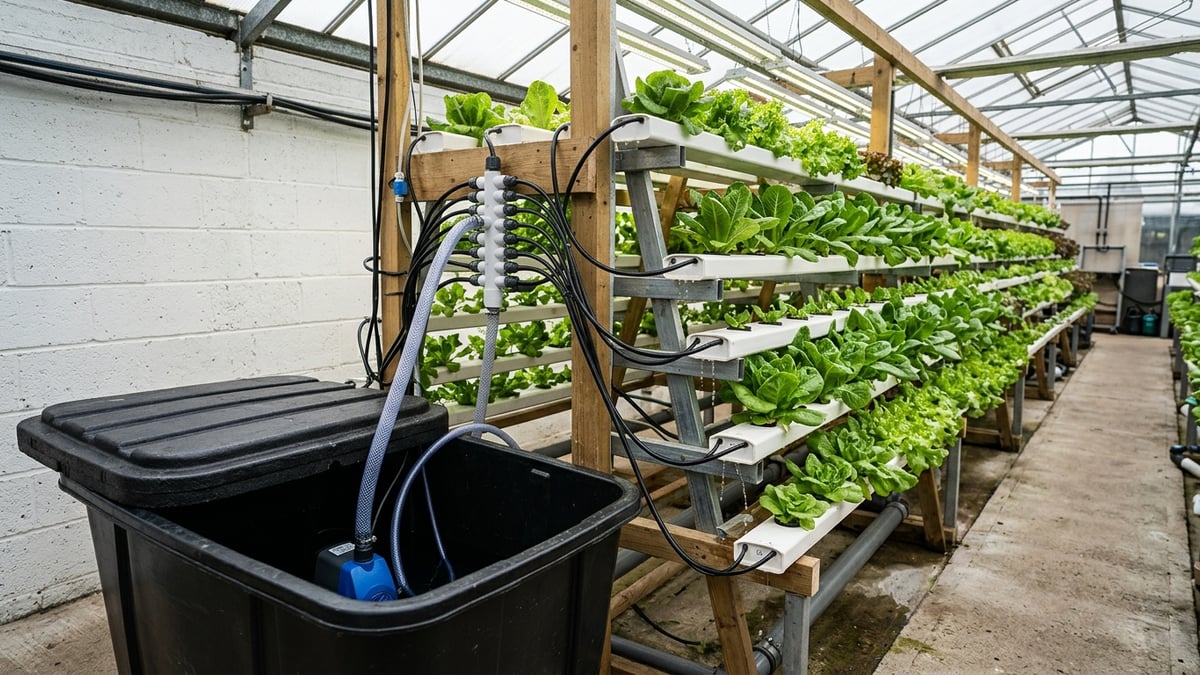
The NFT pump calculation
Virginia Tech suggests 3–5 US gallons per hour into each NFT channel. That converts to roughly 11–19 litres per hour per channel.
Use the source figure as a starting range, then confirm a thin continuous film at your inlet. Crop roots and channel design can change resistance.
Required delivered flow = channel count × target flow per channel.
| Channels | Starting delivered range | What to verify |
|---|---|---|
| 2 | 22–38 L/h | Equal inlet flow |
| 4 | 44–76 L/h | Return handles total flow |
| 6 | 66–114 L/h | End roots stay moist |
| 8 | 88–152 L/h | Manifold remains balanced |
These are delivered figures, not the pump’s zero-head label. Read our complete NFT guide before fixing channel height.
Measure head height correctly
Head height is the vertical distance from reservoir water level to the highest outlet. It is not the total hose length.
Every pump has a performance curve. Flow falls as lift increases. Maximum head is where flow reaches almost zero, not a useful working point.
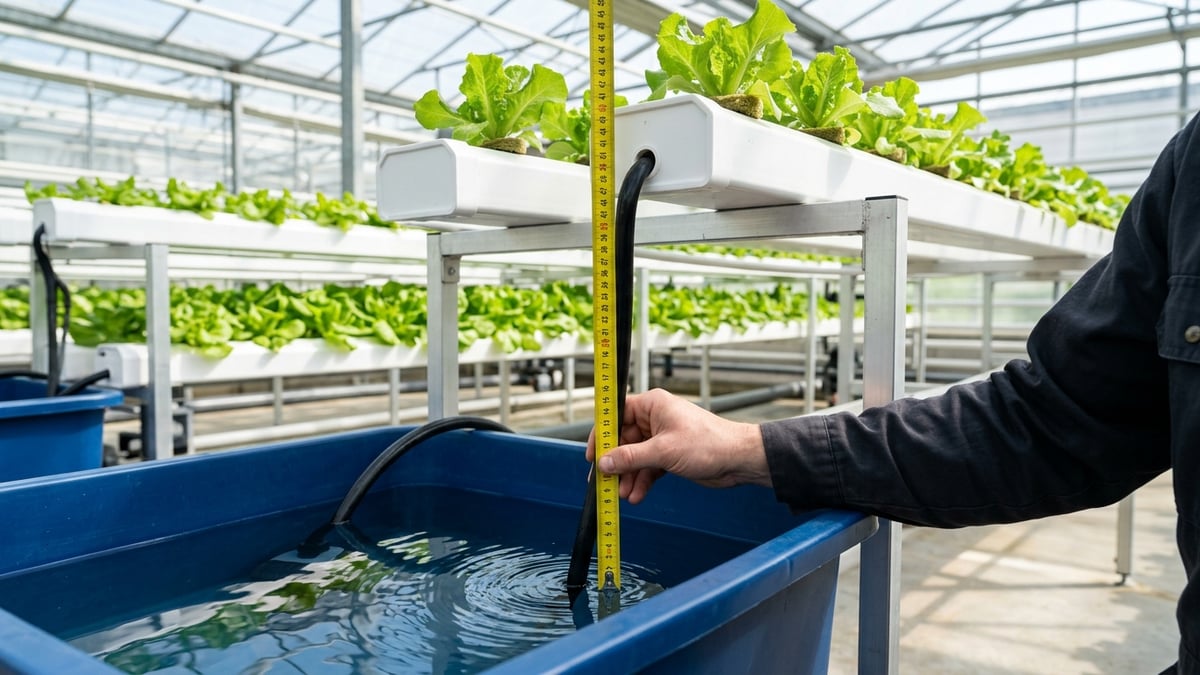
Pipework changes the result
Narrow hose, elbows, valves and a crowded manifold reduce delivery. Root fragments can also obstruct small inlets.
Build the complete feed line, then catch each outlet for 60 seconds. Measure the collected litres instead of guessing from appearance.
- Fill the reservoir to its normal working level.
- Run every channel together.
- Collect one channel’s discharge for one minute.
- Repeat across all inlets.
- Adjust valves until delivery is acceptably even.
A four-channel worked example
Four channels at 15 litres per hour each need 60 litres per hour of delivered flow. That is only one litre per minute in total.
The selected pump must still deliver that amount at the measured lift. Its printed zero-head flow may be much higher.
Test every inlet separately. Results of 14, 16, 15 and 15 litres per hour average correctly and remain well balanced.
Results of 25, 20, 10 and 5 do not. The total is identical, but the final channel receives too little.
Adjust the manifold before increasing the overall flow. An oversized first channel can hide starvation elsewhere.
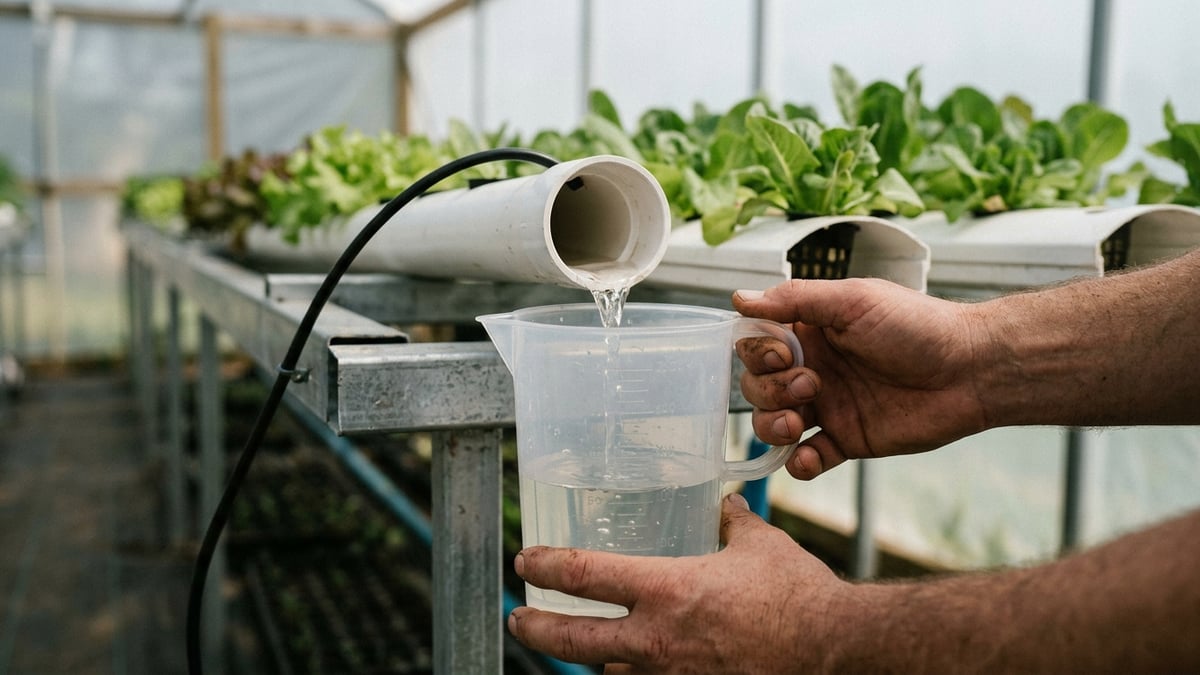
Do not solve poor flow with excessive flooding
A larger pump cannot correct a level channel, blocked return or poor manifold. Excess flow creates deep water and reduces the intended air space.
Set a modest channel slope, keep the return clear and support the channel. Recheck after mature roots fill the floor.
Size the return as well as the feed
All delivered water must return without backing up. A narrow outlet can flood channels even when their inlets are correctly set.
Keep the return route continuously downhill. Low points hold debris and can develop slow, stagnant sections.
Use a removable screen only when it can be inspected easily. A hidden fine screen may block faster than an open return.
Run a power-off test. Water already inside the channels should drain without overflowing the reservoir.
Reservoir choice affects pump reliability
A small reservoir changes level quickly. That alters lift and may expose a submersible pump. A covered reservoir also limits algae and debris.

Buy the AutoPot 47-litre reservoir for £36 →
Compare capacities in our reservoir sizing guide. Browse more watering equipment for your feed and return.
Plan for a stopped pump
NFT roots lose their moving supply immediately when a pump stops. Keep inlets visible and check flow every day.
A spare matching pump reduces recovery time. Clean the intake and keep the electrical connection above possible spills.
Buying checklist
- Find the pump curve, not only maximum flow.
- Measure vertical lift at minimum water level.
- Confirm the outlet fits available hose.
- Choose adjustable delivery or add proper valves.
- Check safe continuous-duty operation.
- Leave access for intake cleaning.
- Keep an equivalent spare nearby.
Commission the system before planting
Run plain water through the finished layout for several hours. Check joints, channel supports and return capacity during this test.
Mark each valve once flows are balanced. A paint pen provides a useful reference after cleaning or accidental adjustment.
Stop the pump and watch the drain-down. The reservoir must accept returning water without reaching its lid or cable openings.
Restart at the minimum working level. The pump should prime reliably and deliver similar results across every channel.
Repeat the timed collection after adding young plants. Then repeat when roots begin spreading along the channel floor.
Frequently asked questions
How many litres per hour does NFT need?
Calculate per channel, then confirm the delivered flow at the actual lift and pipe resistance.
Is maximum head the working height?
No. At maximum head, useful flow is near zero. Read the pump curve.
Can an NFT pump be too large?
Yes. Oversized uncontrolled flow can flood channels and overwhelm the return.
Should an NFT pump run constantly?
Standard NFT uses continuous flow. Timed pumping creates faster root-zone drying during off periods.
Why is the last channel weak?
Inspect manifold balance, hose resistance, debris and lift before increasing pump size.
Does NFT need a spare pump?
It is sensible because root stress begins quickly when the nutrient film stops.
Related reading
Reference: Virginia Tech NFT production guidance.