Grow Room Ventilation: How to Size Fans and Filters
Written by Matt W on 12th Jun 2026.
Grow room ventilation comes down to one calculation: extract the full air volume of the space every one to three minutes, then add 25 to 35% to cover the carbon filter. A 1.2m grow tent holds 2.88m³ of air and wants a fan rated around 230 m³/h once the filter is on. Undersize the fan and you grow mould. This guide does the maths for the spaces UK growers actually run.
Key Takeaways
- Fan size = space volume in m³ x air changes per hour, plus 25-35% for the carbon filter
- A 1.2 x 1.2 x 2m tent needs roughly 230 m³/h of real airflow. A 0.35m² cabinet manages on a 185 m³/h combo
- Run carbon filters at their optimal rating, not their maximum. The PK1604 is happiest at 720 m³/h despite a 960 max
- EC fans cut electricity use by up to 50% against AC equivalents and speed-control without humming
- Negative pressure is the smell seal: extract slightly more than you let in and odours cannot escape
- Carbon lasts about 8 months of continuous running before it stops adsorbing

Shop Ventilation and Filters →
Grower's Note
Ventilation is the least glamorous purchase in the room and the one that decides whether the glamorous ones work. Lights get the attention. The fan decides your temperature, your humidity, your smell and half your noise. Buy it with the same care as the light, size it with headroom, and run it slower and quieter for the rest of its life.
Why does a grow space need an extractor fan?
Four jobs, all happening at once. Heat removal first: even efficient LEDs turn most of their wattage into warmth, and a sealed box cooks in hours. Humidity second: plants transpire constantly, and still, damp air above 70% RH is how botrytis and powdery mildew start. Third, CO₂ refresh, because plants in a sealed space strip the carbon out of the air and stall. Fourth, smell, which the extractor pulls through a carbon filter before the air leaves.
The same fan does all four jobs simultaneously, which is why sizing it correctly matters more than any other single decision in the room.
How do you size an extractor fan?
Multiply the space's volume by the air changes you want per hour, then add filter headroom. The standard target is a full air change every one to three minutes, so volume x 20 to volume x 60 per hour. Worked example for a 1.2 x 1.2 x 2m tent: 2.88m³ x 60 = 173 m³/h, plus 35% for the filter and a duct bend, lands at about 230 m³/h. Here is the map for common UK setups:
| Space | Air volume | Airflow needed | Our match | Price |
|---|---|---|---|---|
| 0.35m² cabinet | ~0.66m³ | 50-90 m³/h | Compact fan and filter set | Compare current sets |
| 1m² cabinet | ~1.6m³ | 130-220 m³/h | GT 160 2-speed + Eco filter, 800 m³/h | £229 |
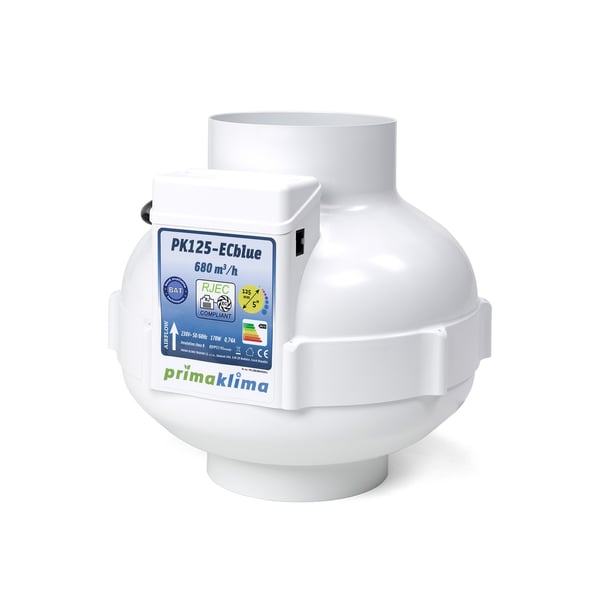
| 1.2m tent | 2.88m³ | ~230 m³/h | PK125 ECblue, 680 m³/h dialled down | £309 |
| 2.4m tent / box room | ~11m³ | 700-900 m³/h | PK160 ECblue, 1180 m³/h | £379 |
| Dedicated grow room | 15m³+ | 1,000+ m³/h | PK200 ECblue, 1350 m³/h | £395 |
Notice the pattern in that "our match" column: every fan is rated well above the bare requirement. That is deliberate. A big fan loafing at 40% is quiet, efficient and has headroom for a heatwave. A small fan flat out at 100% is loud, stressed and still losing the battle in July.
Do you need a carbon filter?
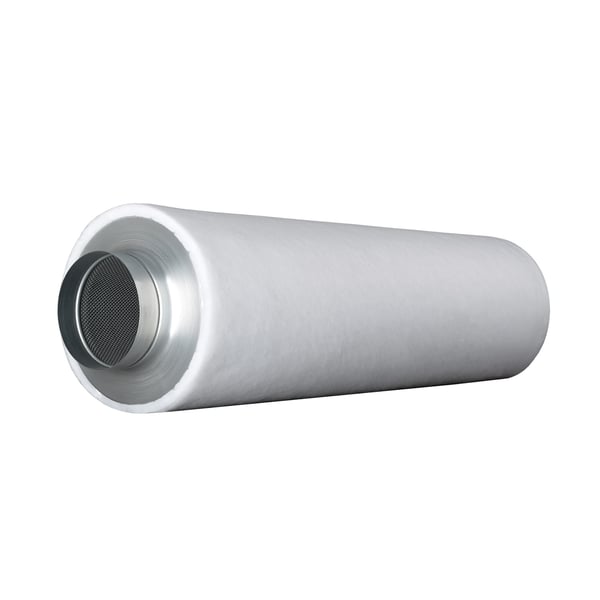
If the grow is anywhere people live, yes. An activated carbon filter strips odour molecules from the air as the fan pulls it through, and it is the only reliable way to keep a growing room smelling like a room. Two sizing rules keep it honest. First, match the filter to the fan's real duty, using the filter's optimal rating rather than its maximum: the PK1604 carries a 960 m³/h maximum but does its best odour scrubbing at 720. Second, expect the filter to cost the fan 25 to 35% of its free-air flow, which is the headroom we built into the table above.
Carbon is a consumable. After roughly 8 months of continuous running the surface is saturated and smells start slipping through. The pre-filter sleeve catches dust and stretches that life, so wash it monthly.
|
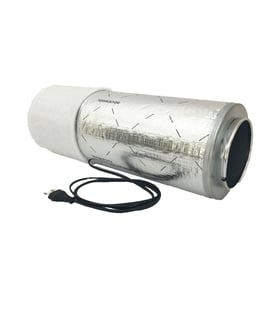
Matt's Pick for Small SpacesBest for: cabinets and small tents running lights up to 250W Why we rate it: fan, Prima Klima K2600 filter and a Rockwool-clad silencer arrive as one pre-cabled, 550mm unit that stays under 40dB. Sizing mistakes are impossible because the matching is done at the factory, and the whole thing fits a 121mm wall hole with the supplied flange. |
EC fans vs AC fans: what is the difference?
The motor. An EC, or electronically commutated, motor is brushless and digitally driven, so it holds any speed from 0 to 100% without the hum AC fans develop on a dimmer. At partial speeds, where an extraction fan spends nearly all its life, EC motors use up to 50% less electricity than AC equivalents.
The other half of the argument is control. The ECblue fans carry an RJ45 port for a Prima Klima digital controller, which ramps the fan speed automatically against a temperature probe. Hot afternoon, fan speeds up. Cool night, it settles back to a murmur. Set the target once and the room manages itself. That matters double with LED lighting, where the heat load swings with the dimmer; our guide to LED running costs covers that side of the equation.
How do you keep a grow room quiet?
Oversize the fan and slow it down: that single decision removes most of the noise problem. Then deal with the three remaining sources. Duct rumble drops with a silencer, a Rockwool-lined tube that takes the edge off airflow noise for the cost of 550mm of duct run. Vibration passes into walls and floors wherever the fan touches the structure, so hang it on rubber mounts or foam rather than screwing it rigid. And intake whistle disappears when the passive intake area is comfortably larger than the exhaust.
Keep slight negative pressure while you are at it: extract a touch more than the intake lets in, and every gap in the space leaks inwards rather than outwards. That is the smell seal. It is also exactly what G-Tools builds into the Clima cabinets as standard, which we cover in our comparison of grow cabinets and grow tents. Watering systems complete the picture, and our walkthrough of ebb and flow hydroponics handles that.
Grower's Tip: hang the filter, do not shelf it
A carbon filter is heavier than it looks. The PK1604 weighs 9.9kg before it has collected a gram of dust. Hang it from the frame or ceiling with rated strap hangers rather than resting it on ducting, because flexible duct will slowly crush, choke the airflow and make the fan work for nothing. Two straps, two minutes, done properly once.
"We stock Prima Klima because the ratings are real. The PK1604 publishes an optimal figure below its maximum, which is the honest way to rate a carbon filter. Pair an ECblue fan with the digital controller and you get a room that holds temperature on its own, using half the electricity of the AC fan it replaced."
- Matt W, Hydroponics UK
Frequently asked questions
What size extractor fan do I need for a 1.2m grow tent?
Around 230 m³/h of real airflow after the filter. The tent holds 2.88m³; one air change a minute is 173 m³/h, and the carbon filter adds a third again. A 680 m³/h EC fan run slow does it quietly.
Should an extractor fan run all the time?
Yes, continuously, with speed varying by temperature. Plants transpire around the clock and humidity climbs fast in still air. An EC fan on a digital controller idles quietly at night and ramps in the heat.
How long does a carbon filter last?
About 8 months of continuous running. After that the carbon is saturated and odour starts slipping through. Washing the pre-filter sleeve monthly stretches the carbon's working life.
Why is my grow tent smelling despite a carbon filter?
Usually lost negative pressure or exhausted carbon. Check the tent pulls inwards slightly when zipped. If pressure is fine and the filter is past 8 months old, the carbon is done.
Are EC fans worth the extra cost?
Yes, for any fan that runs daily. Up to 50% lower electricity use at partial speeds, silent speed control and controller automation pay back the difference over a season or two.
Does a carbon filter reduce fan performance?
Yes, expect to lose 25 to 35% of rated airflow. Always size the fan with that margin included, and use the filter's optimal rating rather than its maximum when matching the pair.